
Honest Chimney Repointing Lawrence NY: 2026 Guide for Lido Beach Residents
Salt air off Reynolds Channel does things to mortar that most homeowners never think about until a chunk falls into the flower bed. Along the barrier island communities Lido Beach, Atlantic Beach, Point Lookout chimneys age faster than they do just a few miles inland, and the mortar joints are usually the first thing to go. Chimney repointing Lawrence NY is one of the most requested repairs we handle each year, and it is also one of the most misunderstood. Homeowners often expect a quick patch job and are surprised when we show up with grinders, custom mortar mixes, and a process that takes a full day or more. That is not a complaint — it is just what the job actually requires when it is done right.
Below we walk through the real problems we diagnose, how we find them, and what fixing them honestly involves.
What Brought Us to a Lido Beach Home Last February
A homeowner in Lido Beach noticed a white powdery residue spreading down the upper courses of his chimney after the January freeze-thaw cycle. He assumed it was surface dirt and rinsed it off with a garden hose. By February the staining was back, and this time there were thin horizontal cracks running through several mortar joints near the cap. He called us expecting a cleaning. What we found was more significant: the mortar had receded nearly half an inch in spots, the joints had been bridged with a surface-only caulk repair at some point in the past, and water had been tracking into the brick face for at least two seasons. We’ll come back to how that job resolved.
The Problems We Actually Find and How We Diagnose Them
Recessed or Eroded Mortar Joints
This is the most common finding. Mortar between courses wears at a different rate than the brick face, and in a coastal environment the gap opens faster because salt crystals expand inside the joint during freeze-thaw cycles. The symptom is visible recession joints that look shadowed or hollow when you run a finger across them. The diagnostic step is probing with a screwdriver or pick; sound mortar resists, compromised mortar powders or gives. If the recession is deeper than three-eighths of an inch, surface patching will not bond correctly and will fail within a season. The fix is cutting the old mortar out to a proper depth typically three-quarters of an inch minimum and packing in fresh mortar in lifts rather than one thick application.
Caulk-Over-Mortar Band-Aids
We see this constantly in older homes in Woodmere, Cedarhurst, and along the barrier beaches. A previous contractor or ambitious homeowner filled deteriorated joints with flexible caulk or hydraulic cement. It looks solid from the ground. Up close, the caulk has pulled away from the brick edges, creating a channel that directs water inward rather than shedding it. The caulk also prevents us from reading the true condition of the underlying mortar. Diagnosis involves probing the margins of the caulk and, in some cases, using our camera inspection tools to check the interior flue condition, because if water has been tracking this long, the liner may be affected too. The fix requires removing all the caulk mechanically grinders or oscillating tools — before any repointing can start. There is no shortcut.
Spalled or Face-Cracked Brick
Repointing addresses the joints, not the bricks themselves, and homeowners sometimes arrive at this conversation expecting one repair to cover both. Spalled brick where the face has popped or flaked — indicates water absorbed into the brick body and expanded during freezing. The symptom is flaking faces, exposed aggregate, or brick that sounds hollow when tapped. The cause in Lido Beach and Harbor Isle is almost always a combination of age, coastal moisture saturation, and previous sealing with the wrong product that traps vapor inside the brick. Repointing the joints will stop new water entry, but spalled brick needs to be assessed individually. Severely damaged units may need to be cut out and replaced before we repoint the surrounding courses otherwise we are just sealing a failed assembly.
Crown and Cap Failures That Get Blamed on the Mortar
A cracked chimney crown — the concrete or mortar wash that covers the top of the chimney — allows water to run directly down behind the brick face, saturating joints from above. We have seen Lawrence NY chimneys where the joints on the upper two feet looked fine on the surface but were wet and soft underneath because the crown had a hairline crack that went unnoticed. The symptom is joint deterioration that starts at the top courses and tracks downward. The diagnostic step is inspecting the crown directly, which requires getting on the roof. The fix is repairing or replacing the crown before repointing otherwise the new mortar absorbs the same water within months. This is why we never quote repointing from the ground alone.
Wrong Mortar Mix From a Previous Job
Mortar hardness has to be matched to the brick. Pre-Civil War and early twentieth century homes in communities like Inwood and North Woodmere often have soft, historic brick that requires a lime-based mortar with low compressive strength. Using modern Portland-heavy mortar on soft brick transfers stress into the brick face rather than the joint, and you end up with spalling that did not exist before the repointing. The symptom is accelerating brick damage in the years after a repair. Diagnosis involves examining the mortar color, texture, and hardness relative to the surrounding brick, and sometimes a simple scratch test. The fix requires removing the incompatible mortar completely and replacing it with a correctly specified mix — Type N or a lime-putty blend depending on the brick age and composition.
Efflorescence as a Diagnostic Signal
That white powdery residue — which is exactly what the Lido Beach homeowner saw — is efflorescence: mineral salts dissolved by water and deposited on the surface as the water evaporates. It is not structurally dangerous on its own, but it is a reliable indicator that water is moving through the masonry. Brushing it off without finding the source just delays the conversation. We use efflorescence patterns to trace water pathways: a bloom below a specific joint line points to that section; a bloom running vertically suggests a crack rather than joint failure. The fix depends on the source — repointing, crown repair, or in some cases adding a proper chimney cap where one is missing or undersized.
What the Repointing Process Honestly Looks Like
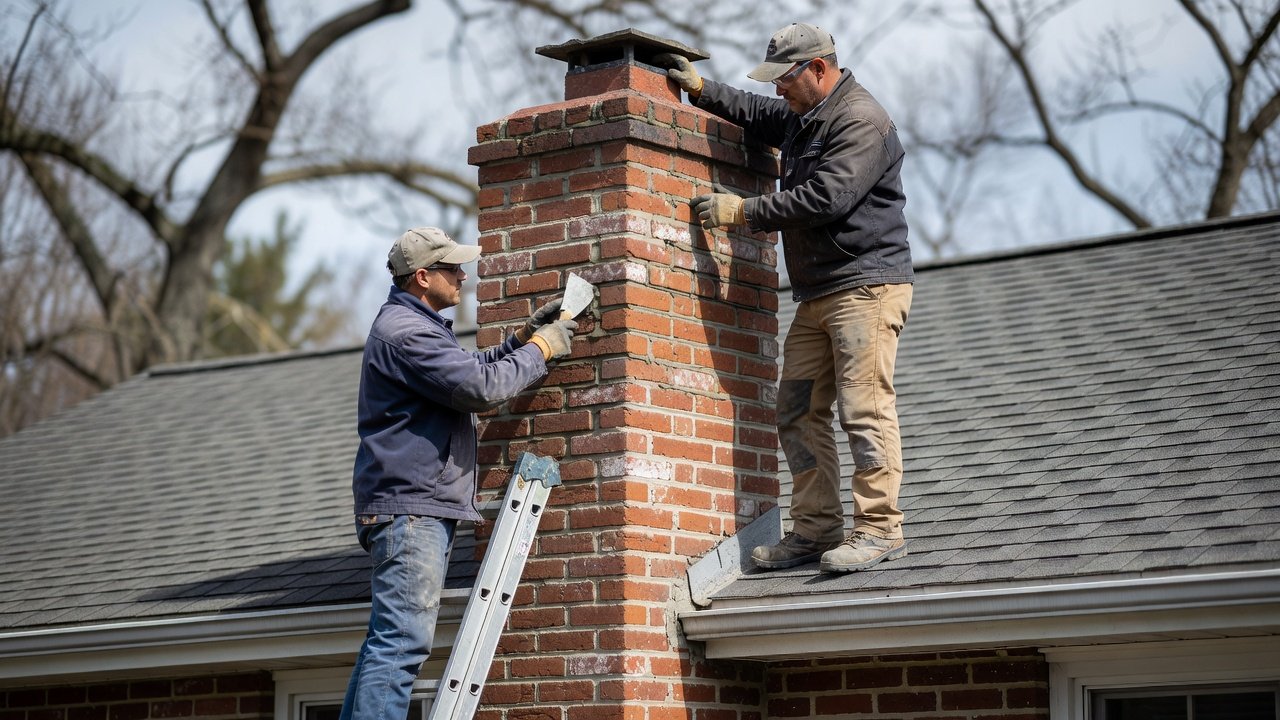
We are going to be direct here because unrealistic expectations cause problems for everyone. A proper repointing job on a standard two-story home chimney in the Lawrence NY area takes most of a day, sometimes two. We set up staging or use ladder jacks safely — working off a ladder alone does not give us the control to cut and pack joints correctly. Joint removal with an angle grinder creates dust, and we contain it as well as possible, but homeowners should expect some cleanup around the base. We pack mortar in stages, tool the joints to match the original profile, and the fresh mortar needs to cure before it can be wet down or sealed. Rushing the cure with a sealer application the same day is a mistake we will not make.
The National Fire Protection Association (NFPA 211) recommends that chimneys, fireplaces, and vents be inspected at least once a year and cleaned as needed — and that inspection is what catches mortar problems before they become structural failures. According to the Chimney Safety Institute of America (CSIA), chimney fires account for approximately 25,000 house fires annually in the United States, causing over $125 million in property damage — and compromised mortar joints that allow moisture into the structure are a contributing factor in many of those cases. Getting ahead of joint erosion is not an aesthetic choice; it is a fire and structural safety decision.
Back to That Lido Beach Job
After removing the old caulk and grinding the joints to proper depth, we found the crown had a two-inch diagonal crack that had been there for years. We repaired the crown first, let it cure overnight, then repointed the upper and mid-sections of the chimney with a Type N mortar matched to the original color and texture. The homeowner also had us inspect the flue lining through our chimney inspection service — the liner was intact but had minor sooting that we cleared. Total time on site was just over a day. The efflorescence has not returned through the balance of the season, which is the result you want.
Can This Be Prevented?
Partly. Mortar will always weather faster than brick, particularly along the South Shore where Atlantic exposure accelerates the cycle. What slows it down is keeping water out from above — a quality chimney cap, an intact crown, and a proper breathable water-repellent treatment applied to the right type of brick. Annual inspections catch early recession before it becomes a structural problem. HomeAdvisor and Angi report that national average chimney repair costs range significantly by scope; catching joint erosion early, when only selective repointing is needed, is substantially less expensive than a full chimney rebuild — which is where deferred maintenance on Long Island barrier island homes tends to end up.
Talk to Us Before the Next Storm Season
Homes in Lido Beach, Atlantic Beach, and across the Lawrence NY area take real punishment from coastal weather. If you have seen cracking, staining, or mortar that crumbles when you touch it, we are glad to come take a proper look — from the roof, not just the driveway. We will give you an honest assessment and a written scope before any work begins. Reach out through our website contact form to schedule a free estimate. We work throughout Nassau County and know these barrier island homes well.
Frequently Asked Questions: Chimney Repointing in Lawrence NY
How do I know if my chimney needs repointing or a full rebuild?
Repointing is appropriate when the bricks themselves are structurally sound but the mortar joints have eroded, cracked, or been poorly repaired. A full rebuild becomes necessary when multiple courses of brick have shifted, spalled severely, or when the chimney structure has leaned or separated. We assess this from the roof during an inspection — a ground-level look is not enough to make that call reliably.
How long does chimney repointing last in a coastal area like Lido Beach?
A proper repointing job using correctly specified mortar should last 20 to 30 years under normal conditions. In a salt-air environment on the barrier beaches, expect the lower end of that range if water management above — cap, crown, flashing — is not also maintained. The mortar itself is not the only variable.
Is chimney repointing covered by homeowners insurance in New York?
Standard homeowners insurance policies typically cover chimney damage from sudden, accidental events like a windstorm or lightning strike. Gradual mortar deterioration from weathering or deferred maintenance is almost always excluded. This is one reason annual inspections matter — documented maintenance history supports any future claim and demonstrates the damage was not from neglect.
Can I repoint just part of the chimney, or does the whole thing need to be done at once?
Selective repointing is entirely legitimate when only specific sections have failed. We will not tell you to repoint a chimney that does not need it. That said, if the mortar across the whole chimney is within a few years of the same age and condition, doing it in sections often costs more total than addressing it together. We will walk you through what we find and let you decide.
What is the difference between repointing and tuckpointing?
Tuckpointing in its traditional sense means using two contrasting mortar colors — one to fill the joint and a thin line of contrasting color to create the illusion of fine joints. In common use, especially on Long Island, most homeowners and contractors use the terms interchangeably to mean removing deteriorated mortar and replacing it. We will clarify exactly what your chimney needs when we assess it, rather than defaulting to terminology.
Do you need permits for chimney repointing in Nassau County?
Routine repointing of existing mortar joints generally does not require a building permit in Nassau County. Structural work — replacing multiple courses of brick, rebuilding a chimney section, or altering chimney height — typically does require a permit. We will advise you on what applies to your specific job before we start.
Related from Lawrence Chimney: What Atlantic Beach Homeowners Should Know Before Booking a Chimney Sw · Chimney Sweep in Lawrence, NY · Smart Chimney Cap Installation Lawrence NY
Pingback: Smart Chimney Repair Inwood NY: 2026 Guide for Lido Beach Residents – Lawrence Chimney