
Smart Chimney Repair Inwood NY: 2026 Guide for Lido Beach Residents
How do you know whether the contractor quoting your chimney repair actually understands what they are looking at? That question matters more than most homeowners realize and around the South Shore, we see the consequences of the wrong answer every single season.
We do a fair amount of chimney repair in Inwood NY and across the neighboring communities, so we know what the housing stock looks like and what the coastal environment does to masonry over time. Lido Beach sits right on the Atlantic barrier island, and the combination of salt-laden sea air, hard winters, and repeated freeze-thaw cycles between December and March is genuinely punishing on mortar joints, crowns, and flashing. A chimney that looked fine in October can be weeping water into a firebox by February. What separates a clean repair from an expensive callback is almost always the quality of the diagnosis — and the credentials of the person doing it.
This post walks through the problems we see most often, how a competent technician actually diagnoses them, and what you should be asking any contractor before you let them near your roofline.
A Situation We Encountered in Lido Beach Last Winter
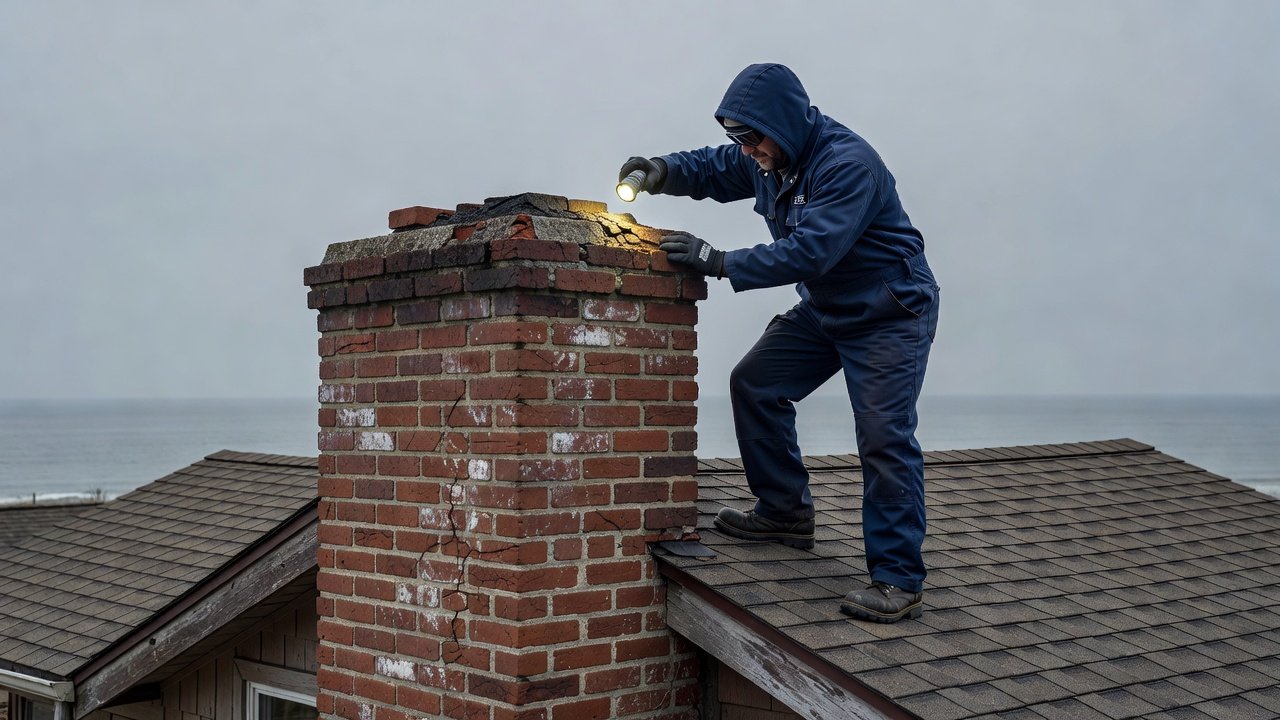
A homeowner near the ocean side of Lido Beach called us after a competing contractor had already been out and quoted a full chimney rebuild. The complaint was water in the firebox and a crumbling interior. When our technician climbed up, the crown had a single, significant crack running its full width not unusual given the salt air and the temperature swings we see on the barrier island. The flashing had lifted at one seam. That was the whole story. We sealed the crown with a professional-grade elastomeric treatment and re-secured the flashing. No rebuild needed. The homeowner saved well over two thousand dollars because someone took the time to look carefully before reaching a conclusion.
That is not a knock on every other company. It is an illustration of why the diagnostic step is where a chimney repair job is either done right or set up to fail.
The Problems We Diagnose Most Often and What They Actually Mean
Deteriorated Mortar Joints
Symptoms: visible gaps between bricks, white mineral staining (efflorescence) running down the exterior, or bricks that move slightly under hand pressure. On the South Shore from Lido Beach across to Long Beach and down into Inwood the combination of ocean moisture and freeze-thaw expansion eats mortar faster than it does almost anywhere else in Nassau County. The fix is repointing: removing the compromised mortar to a minimum depth of about three-quarters of an inch and packing in new material that matches the original in hardness and composition. Getting the mix wrong is a common contractor error; mortar that is too hard will cause the bricks themselves to spall.
Cracked or Missing Chimney Crown
Symptoms: water appearing in the firebox after rain, chunks of white material collecting on the roof or in the gutter. The crown is the sloped concrete cap that sheds water off the top of the masonry not to be confused with the chimney cap, which is the metal cover over the flue. Hairline cracks can be sealed. A crown that has fractured into multiple sections or that was poured too thin from the start needs to be rebuilt entirely. A probe with a screwdriver tells a technician quickly which situation they are dealing with.
Flashing Failures
Symptoms: water stains on the ceiling near the chimney, rust-colored streaks on interior walls, or daylight visible between the flashing and the masonry. Flashing is the metal seal where the chimney meets the roof. Around Island Park and Harbor Isle, we see a lot of step-flashing that was installed without counter-flashing embedded in the mortar joint, so it relies entirely on caulk which has a short service life in a coastal environment. The real fix is properly set step and counter-flashing, not another bead of sealant over the old one.
Damaged or Deteriorated Flue Liner
This one is invisible from the roof and from the firebox. Symptoms: visible cracks noted during a camera inspection, the smell of smoke in rooms adjacent to the chimney, or soot staining on the exterior masonry above the firebox. The National Fire Protection Association (NFPA 211) recommends that chimneys, fireplaces, and vents be inspected at least once per year and cleaned as needed, regardless of how often the fireplace is used precisely because liner damage is not something a homeowner can detect without a camera. Repair options range from installing a stainless steel liner insert to applying a poured or brushed refractory coating, depending on what the camera shows and what the homeowner uses the appliance for.
Spalling Brick
Symptoms: brick faces popping off, brick dust or fragments collecting at the base of the chimney. This is almost always a moisture problem that has been present long enough for water to migrate into the brick itself, freeze, and fracture the face off. The compromised bricks need to come out and be replaced with units that match as closely as possible in hardness and absorption rate. In older homes in Hewlett and Cedarhurst, we routinely find that original soft brick was patched at some point with harder modern brick a mismatch that accelerates the problem rather than solving it.
Offset or Failing Damper
Symptoms: smoke entering the living space when the fireplace is used, persistent draft problems, or a damper handle that no longer moves freely. A throat damper that has corroded or warped can sometimes be adjusted or replaced in place. More commonly on the South Shore, we find that the original cast-iron throat damper has rusted out completely, and the cleaner solution is a top-selling damper mounted at the flue opening and operated by a stainless cable it eliminates the draft and moisture issue simultaneously. According to the Chimney Safety Institute of America (CSIA), chimney fires account for approximately 25,000 house fires annually in the United States, causing over $125 million in property damage and a compromised damper is one of the mechanisms that allows a chimney fire to spread.
What to Ask Any Contractor Before Signing Anything
The angle of this piece matters because chimney repair in Inwood NY and across Lido Beach, Woodmere, and the rest of the South Shore attracts both genuinely qualified technicians and people who own a ladder and know the words. Here is the short list of things we think every homeowner should ask.
Are your technicians CSIA-certified? The Chimney Safety Institute of America runs the credentialing program that sets the standard for diagnostic and repair competence. A CSIA-certified chimney sweep has passed a written exam, demonstrated field knowledge, and is required to renew certification through continuing education. Ask for the certification number if you have any doubt.
Will you provide a written scope of work before I authorize anything? Any reputable company can tell you in writing exactly what they are repairing, what materials they are using, and what the work does not include. Verbal quotes are fine for ballpark estimates; they are not acceptable for authorizing repair work on a structural component of your home.
Do you carry general liability and workers’ compensation insurance? Ask for a certificate, not just a yes. An uninsured contractor working on your roof creates real liability exposure for you as the property owner if there is an injury.
Red flags to watch for: Quotes given without anyone going on the roof. Pressure to authorize a rebuild after a ten-minute visit. No camera inspection offered before recommending liner work. Contractors who cannot name the specific materials they plan to use. Any quote that is so far below competitors that it raises questions mortar, liner inserts, and flashing materials have real costs that cannot be negotiated away without cutting something.
What Does Chimney Repair Actually Cost in 2026?
Repointing a chimney on a standard two-story home in the Lido Beach and Inwood area typically runs between $400 and $1,200 depending on how many courses are affected and how accessible the chimney is. A crown rebuild runs $250 to $600 in most cases. Flashing repair ranges from $200 to $500. Liner installation the more significant repair typically falls between $1,500 and $4,000 depending on flue dimensions and liner type. According to HomeAdvisor/Angi, the national average cost of a chimney inspection runs $100 to $250 for a Level 1; a camera-based Level 2 inspection, which we recommend before any significant repair authorization, typically adds $100 to $200 to that baseline. Prices on Long Island generally run at or slightly above national averages given regional labor costs.
If someone is quoting you chimney repair in Inwood NY or along the Lido Beach oceanfront and the number seems too good to be true, ask specifically what is included because scope is usually where the discount is hiding.
Can These Problems Be Prevented?
Most of them, yes or at least slowed significantly. Annual inspections catch crown cracking before it becomes a water infiltration problem. A quality waterproofing treatment applied to the exterior masonry every four to five years dramatically reduces moisture absorption in the brick and mortar. Chimney caps keep rain, debris, and animals out of the flue. On a coastal barrier like Lido Beach, those three things annual inspection, periodic waterproofing, and a functioning cap are the difference between a chimney that lasts generations and one that requires major work every few years.
We offer our chimney inspection service, cap installation, and waterproofing as part of the same visit for homeowners who want to address prevention alongside any current repair. It is more efficient and usually more cost-effective than scheduling them separately.
Talk to Us Before You Authorize Any Repair
If you are a homeowner in Lido Beach, Inwood, Long Beach, or anywhere else along the South Shore and you have gotten a repair quote that you are not sure about or if you have noticed any of the symptoms described above we are happy to give you an honest second look. We are not going to climb down and tell you everything is fine when it is not, and we are not going to recommend work that your chimney does not need. Use the contact form on our website to request a free estimate and we will get a technician out to you.
Frequently Asked Questions: Chimney Repair in Inwood NY and Lido Beach
How do I know if my chimney needs repair or just cleaning?
Cleaning removes creosote and debris from the flue. Repair addresses structural or material failures cracked crowns, deteriorated mortar, damaged liners, failed flashing. The two are related because a clean chimney is easier to inspect properly, but they are not the same thing. If you are seeing water in the firebox, spalling brick, or smoke entering the living space, those are repair indicators, not cleaning indicators. We typically combine an inspection with every sweep so we can give you a clear picture of both.
Is chimney repair covered by homeowners insurance in New York?
Standard homeowners’ insurance in New York generally covers chimney damage caused by a sudden, accidental event a windstorm, a lightning strike, a falling tree. It does not cover deterioration from age, lack of maintenance, or gradual water damage. That distinction matters because most of the chimney repair, we do on the South Shore involves exactly the kind of slow coastal weathering that insurers exclude. Keeping a record of annual inspections strengthens your position if you ever do make a claim for covered damage.
How long does chimney repointing last on Long Island?
Done correctly with the right mortar mix for the existing brick, repointing typically lasts 20 to 30 years in inland areas. On a barrier island like Lido Beach or in a coastal community like Atlantic Beach, the salt air and moisture exposure can shorten that to 15 to 20 years. The quality of the mortar mix and the thoroughness of joint preparation are the biggest variables which is why the contractor’s technical knowledge matters as much as the price.
What is a Level 2 chimney inspection and when do I need one before repairs?
A Level 2 inspection, as defined by NFPA 211, includes a camera scan of the full flue interior and all accessible portions of the chimney structure. It is the appropriate inspection whenever you are buying or selling a home, after any chimney fire or significant weather event, or before authorizing liner repair or replacement. Without camera footage, a technician is making educated guesses about the condition of the liner. We always recommend a Level 2 before any significant repair so the scope of work is based on evidence rather than assumption.
How do I find a qualified chimney repair contractor near Inwood or Lido Beach?
Look for CSIA-certified technicians, verify insurance before any work begins, and ask for a written scope of work. Get at least two opinions if a contractor is recommending a full rebuild after a short visit. Local contractors who work the South Shore regularly Hewlett, North Woodmere, Inwood, the barrier island communities understand the coastal exposure conditions here in a way that a general handyman or roofer typically does not. The chimney system interacts with the roofline, the appliance, and the structural masonry; it is a specialist job.
What happens if I delay chimney repair?
Small problems compound. A hairline crown crack that costs a few hundred dollars to seal this year can allow enough water penetration to deteriorate the liner and the upper courses of brick within two or three seasons repairs that can run into the thousands. On the South Shore, where freeze-thaw cycles are hard and coastal moisture is constant, the window between “manageable repair” and “significant reconstruction” closes faster than it does in drier inland climates. Early attention is almost always the less expensive path.
Related from Lawrence Chimney: Smart Chimney Sweep Inwood NY · Honest Chimney Repointing Lawrence NY